
The Problem With Cheap AI: It Won’t Stay Cheap
The average business doesn't need AI pricing that's low. It needs AI pricing that is set at the right level to be sustainable.
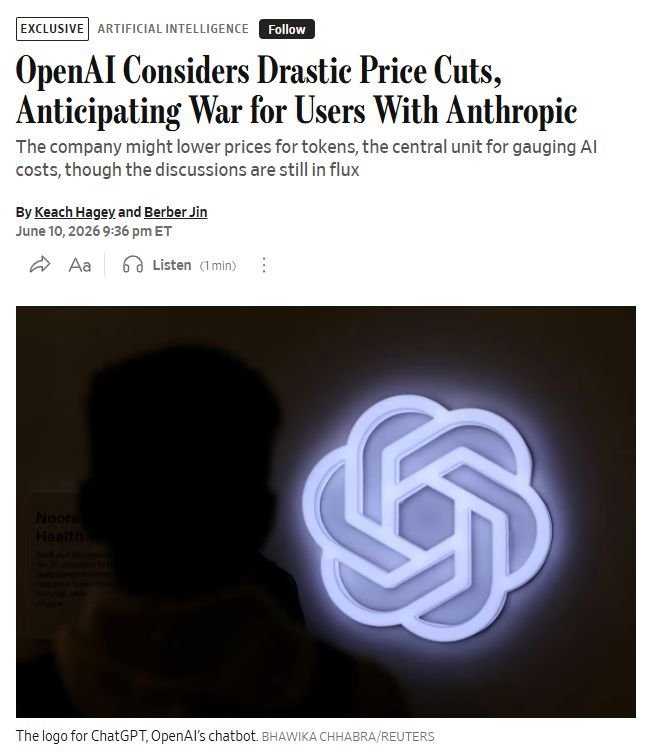
Reporting has appeared suggesting that OpenAI is considering drastic price reductions to outmaneuver Anthropic that might be planning the same. Yet given that the AI labs seem to run as money furnaces, whether there is margin to give away is an open question.
No one wants to turn down a good discount. But price reductions tied to market expansion and not cost efficiency just defer the budgetary pain. Long term planning requires knowing the fair sustainable market price, and in the world of AI, none of us have that datapoint.
If the argument for AI adoption is productivity enhancement, then making good decisions about how to invest requires benchmarking against the cost of alternative interventions. You can build some agents running on OpenAI's API or hire a couple of new employees. If both actions will enable a similar outcome in terms of productive output, then understanding the long-term cost is an essential metric for your decision.
We can look at what has happened with restaurants and the food delivery market. Services like DoorDash or Uber Eats were unduly cheap while they captured their share. Restaurants leapt in with both feet, as did consumers. And now, years later, many members of both groups are complaining about the unsustainability of the model. Yet, neither can readily unravel the problems they face because they have changed their behavior too much.
The change we are trying to make in business with AI will probably be an order of magnitude more impactful. And this impact won't just be felt in narrow sectors, but across the entire economy. Yet, we are seeing exactly the same playbook, where early business success for AI firms is not measured on how robust their bottom line is but how much money they can lose while capturing a market.
In the last few weeks, the US government has picked up steam on AI policy. Yet this conversation is far too narrow. It is predicated on issues of AI safety and cybersecurity, without recognizing that probably the biggest risk we face from AI is an economic skewing around business costs and labor spend. This is a risk that largely exists because we don't understand the true market cost of the changes we are investing in.
It's hard to find a corollary in history where such profound change is being built on such opaque foundations. The potential upside of this change is real but so too is the risk. And what the economic tensions at the heart of the AI industry keep delivering is anything but durable stability. The railroad bubble left tracks. The dot com bubble left fiber. They were wreckage that was worth picking up. With AI the economics are different - today's GPUs will be tomorrow's eBay deals not a long-term asset of the AI race. The way AI is priced into the change we are making needs to be clearer from the start.
First posted on Linkedin on 06/18/2026 → View Linkedin Post Here
🖼️ from the WSJ