
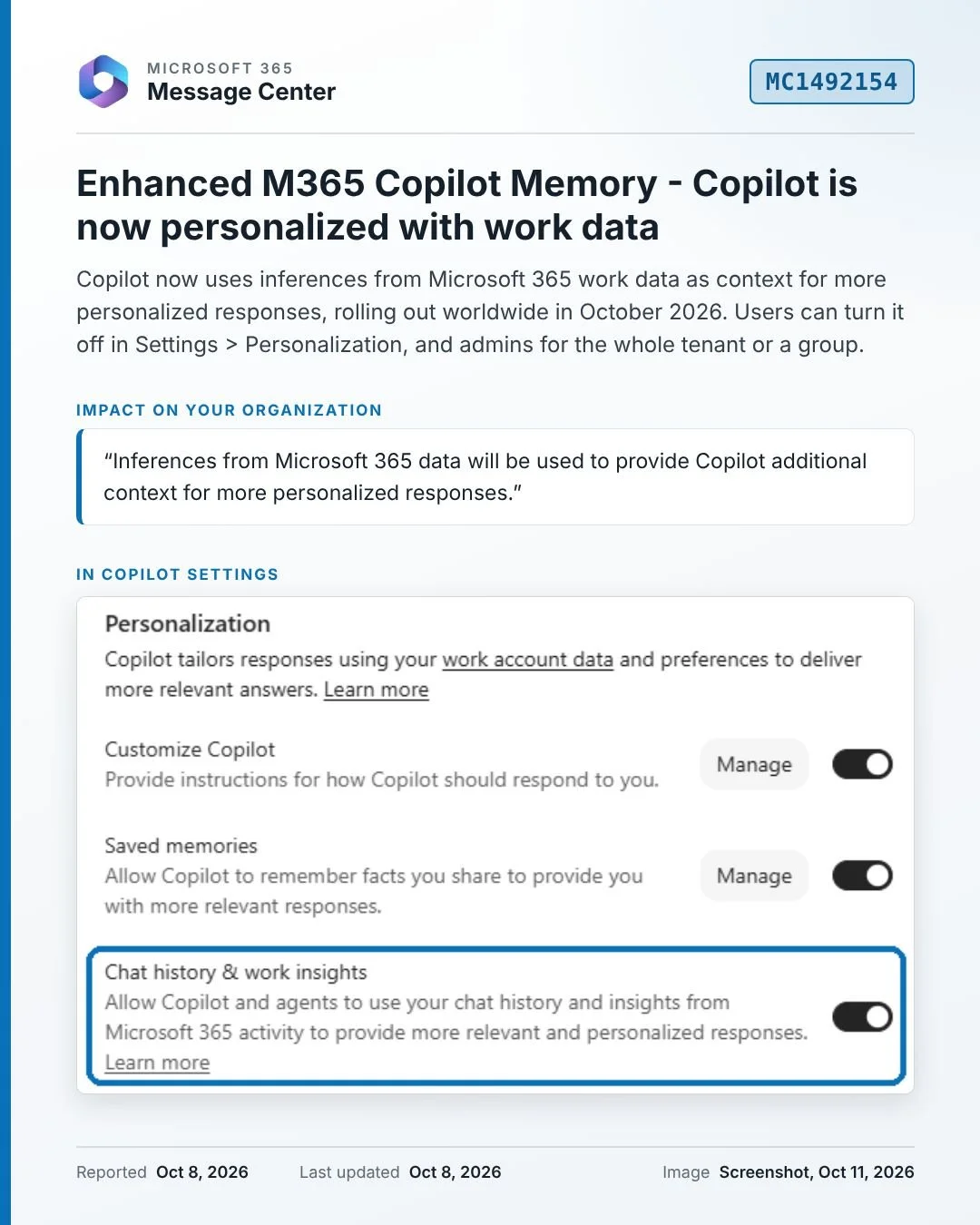
Copilot is further expanding its memory into your Microsoft 365 work data.
MC1492154 says Copilot will use "inferences from Microsoft 365 data" to personalize its responses, rolling out worldwide through October. Microsoft's support page calls these work insights, learned from content such as your emails, Teams chats and meeting transcripts. Users can turn them off with the "Chat history & work insights" toggle in Settings > Personalization. It seems closely related to Communication Memory (MC1127234).
This is exciting. Microsoft natively holds far more of your work context than OpenAI or Anthropic, and turning that into an assistant that understands your priorities with little effort on your part is exactly where Copilot should pull ahead.
But how that understanding gets built matters as much as the understanding itself. Inference is assumption, so Copilot is drawing conclusions about what matters to you. Microsoft publishes guidance on how to turn these features off for admins. Beyond that though, there's little explanation of how these capabilities infer their understanding or even to what degree they are currently active. Not turning something off doesn't make it active, and Communication Memory has been rolling out to General Availability for more than 12 months at this point.
At the user level, Microsoft's advice is to ask Copilot what it knows about you. So I did, and got a set of answers. When I then asked what it knew about me from work insights, I got a slightly different set, along with an explanation that it hadn't queried work insights the first time. Both responses were largely accurate, but as a complete picture of my work preferences were somewhat sparse. This approach to visibility is very different to a competitor like Claude where there's a very clear UI to look at what memories it is holding on an account and project level, while Copilot's is now spread across queries in chat and its Saved Memories list.
This type of personalization brings the challenge of AI alignment down to the personal level. Alignment is usually framed as a problem for the labs, but a personalized assistant asks every user a smaller version of the same question. Is it aligned with what I actually need, and can I see enough to tell?
Copilot's picture of you becoming more complete is great and will help it be even more accurate inside your work context. But the more we rely on these types of inferred insights, the more important being able to touch them becomes. This is the place where there are the biggest opportunities to improve how these features work right now.
What would you want to see to be able to trust that Copilot knows you?
First posted on Linkedin on 10/11/2026 → View Linkedin Post Here